
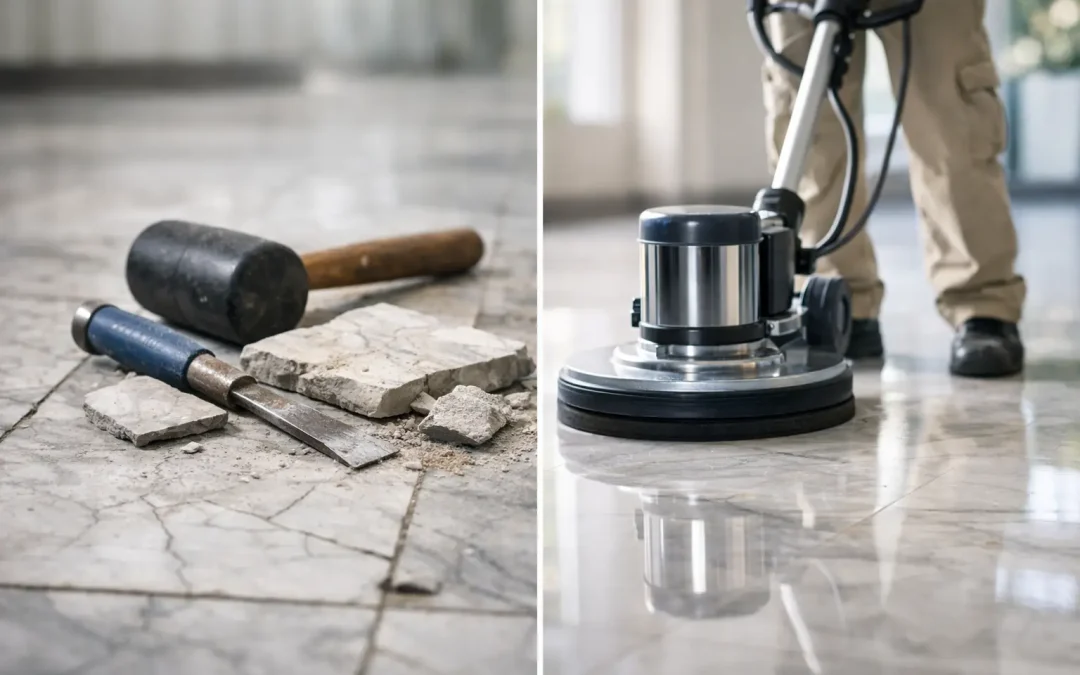
A marble floor that looked elegant a few years ago can start showing every step, spill, and scratch. For many homeowners, the question becomes marble polishing vs replacement – should you restore what you have, or start over? In most cases, professional polishing is the smarter first option because marble is often damaged at the surface, not ruined all the way through.
Marble polishing vs replacement: what changes the decision?
The right answer depends on the type of damage, the age of the installation, and the condition of the stone underneath the wear. Marble is a natural material, so it can etch from acidic products, lose shine in traffic lanes, develop light scratches, and collect stains. Those problems can look serious without actually requiring new tile or slab.
Replacement becomes part of the conversation when the stone is cracked through, tiles are loose because of substrate failure, large sections are missing, or the layout itself has a bigger problem than surface wear. If the marble is structurally sound, restoration is usually the more practical path.
That distinction matters because many homeowners assume dull marble is old marble. Usually, it is just worn marble. There is a big difference.
When polishing makes more sense than replacing
Professional marble polishing is designed to correct surface-level issues and bring back clarity, reflectivity, and a smoother finish. Depending on the condition of the stone, the process may also include honing to remove etching, flatten uneven wear, and improve the overall appearance before the final polish is applied.
This is often the better choice when your marble has traffic patterns, cloudy spots, water marks, light scratches, or a finish that no longer matches from room to room. Those are common signs of wear in kitchens, bathrooms, foyers, and living spaces throughout Gainesville homes.
Polishing also makes sense when you want to preserve the original material. Many homeowners have marble that fits the home beautifully but looks tired because years of use have dulled the finish. Restoring that surface keeps the character of the stone while improving how it looks and feels day to day.
Cost is another reason polishing is usually the first move. Replacing marble involves demolition, disposal, material selection, installation, and often extra work around baseboards, cabinetry, transitions, or adjacent flooring. Polishing avoids most of that disruption. It is typically faster, cleaner, and far more cost-effective when the stone itself is still worth saving.
When replacement is the better investment
There are situations where polishing will not solve the real problem. If marble has deep cracks that run through the tile, major chips along multiple edges, severe lippage caused by installation failure, or water-related movement underneath, restoration may only improve the look temporarily. The underlying issue would still be there.
Replacement may also be the better option when there is widespread staining that has penetrated beyond what can realistically be corrected, especially if the damage is paired with structural issues. The same is true if previous repairs were poorly done or if matching the existing stone is no longer possible in isolated damaged sections.
Some homeowners also choose replacement for design reasons. If you no longer want the color, pattern, tile size, or finish, then restoration is addressing the wrong goal. Polishing can renew marble, but it will not turn one style of floor into another.
What homeowners often mistake for permanent damage
One of the most common misunderstandings with marble is assuming that etching is a stain. Etching happens when acidic substances react with calcium-based stone. That leaves dull spots or rings, especially around sinks, vanities, kitchen counters, and bathroom floors. It can look like damage that goes deep into the stone, but in many cases it can be corrected through honing and polishing.
Another common issue is embedded soil in textured or worn marble. Homeowners may scrub and mop repeatedly without getting the result they want, then assume the marble is beyond repair. Often, the finish has become too open or uneven, which makes the surface hold onto dirt and appear permanently dingy.
Light scratches and cloudy finish loss also tend to look worse under natural light or overhead lighting. That does not automatically mean replacement is needed. It usually means the finish has broken down and needs professional restoration rather than household cleaning.
Marble polishing vs replacement in real-world cost terms
Most homeowners are not comparing these options in theory. They are trying to decide what makes financial sense for the home they already have.
Polishing generally costs less because it works with the existing material. There is no tear-out, no need to buy all new stone, and less interruption to the home. You are paying for skilled restoration rather than for a full removal-and-rebuild project.
Replacement carries a much wider cost range. Material quality, stone availability, demolition complexity, layout changes, and installation details can all push the final number up. Even a small area can become expensive if custom cuts, matching, or subfloor repairs are involved.
That does not mean replacement is always too expensive. It means the value has to be justified by the condition of the marble and the goals of the project. If restoration can deliver the appearance and performance you want, replacing sound marble is often money spent where it does not need to be spent.
The disruption factor most people overlook
Home projects are not judged on price alone. They are also judged on how much they interrupt your routine.
Polishing is usually less invasive. There is no demolition noise, no hauling broken tile through the house, and no waiting on new material orders. For homeowners who want to improve their floors, vanities, or other marble surfaces without turning the house into a construction zone, that matters.
Replacement often affects surrounding finishes too. Baseboards may need attention. Adjacent flooring transitions may no longer line up cleanly. Cabinets, fixtures, or thresholds can complicate the job. What starts as replacing marble can quickly involve several parts of the room.
For busy households, restoration is often appealing because it improves the surface with less mess and less downtime.
How a professional decides whether your marble can be restored
A proper evaluation goes beyond how the marble looks from across the room. A restoration specialist checks whether the damage is surface-level or structural, how deep the scratches or etching go, whether tiles are stable, and how much variation exists from one section to another.
They also consider the marble type, the finish you want, and whether repairs can be blended successfully. Some floors need only polishing. Others need honing first to remove damage before polishing can create an even finish. In some cases, isolated repairs can be combined with restoration so you do not have to replace an entire area.
That is why estimates matter. A good assessment should tell you not just what can be done, but what is worth doing.
Why local homeowners often benefit from restoration first
In homes across Gainesville and nearby North Central Florida communities, marble surfaces deal with daily wear, moisture, tracked-in grit, and cleaning products that slowly change the finish over time. Those conditions often create cosmetic damage long before the stone actually fails.
For that reason, restoration is frequently the better starting point. It protects the investment you already made, improves appearance, and can extend the life of the surface for years when paired with proper care and sealing. For homeowners who value preserving high-end materials instead of replacing them too soon, that approach usually aligns better with both budget and long-term home maintenance.
Natural Surface Restoration works with homeowners facing exactly this kind of decision, helping them tell the difference between marble that looks worn and marble that is truly beyond repair.
The best next step if you are unsure
If you are stuck between polishing and replacement, do not make the call based on appearance alone. Marble can look worse than it is, and once you replace it, there is no going back.
A professional evaluation gives you a clearer answer. If the marble is restorable, polishing can bring back shine, improve the overall look, and save you from a much larger project. If replacement is truly necessary, it is better to know that before spending money trying to correct a problem that restoration cannot fix.
Good marble does not always need to be torn out just because it has lost its finish. Sometimes the better investment is keeping the stone, restoring it properly, and letting it look like it belongs in your home again.