
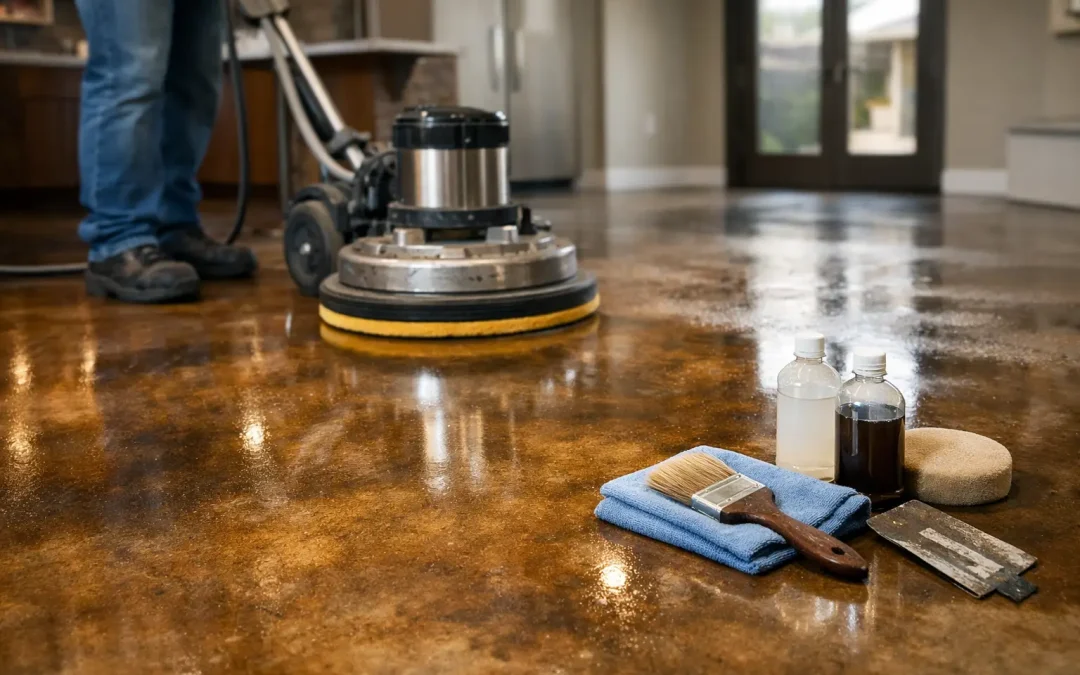
A concrete floor can look tough enough to handle anything, right up until oil spots, rust marks, paint drips, and dull traffic patterns start taking over the room. That is usually the point when homeowners begin looking into stained concrete floor restoration – not because the slab failed, but because the finish no longer looks clean, consistent, or worth showing off.
In homes across Gainesville and surrounding North Central Florida communities, concrete shows up in garages, patios, porches, lanais, workshops, and increasingly inside the home. It is durable, but it is not stain-proof. Once discoloration sets in, many homeowners assume replacement is the only real fix. In most cases, it is not. The better answer is to restore the surface correctly, address what caused the staining, and protect it so the same problem does not come right back.
What stained concrete floor restoration really involves
Restoration is not the same thing as a quick cleaning. If a floor has surface dirt, light residue, or minor film buildup, a standard cleaning may improve the look. But when concrete has absorbed contaminants, developed uneven color, or lost its protective finish, it needs more than soap and a scrub brush.
A proper restoration process starts with identifying what is actually on and in the slab. Some stains sit near the surface. Others penetrate deeper into the pores of the concrete. Oil and grease, for example, can soak in and leave dark shadows even after aggressive cleaning. Rust can leave orange or brown staining that requires targeted treatment. Paint, mastic, adhesive residue, and old coatings often need mechanical removal before the floor can be brought back to a cleaner, more uniform appearance.
That is why stained concrete floor restoration is part cleaning, part surface correction, and part protection. The goal is not just to make the floor look better for a week. The goal is to restore a sound, even, serviceable surface that holds up over time.
Why concrete stains so easily
Concrete is hard, but it is also porous. That matters more than most homeowners realize. Tiny openings in the surface can pull in moisture, oils, dirt, and chemical spills. In garages, that often means tire marks, automotive fluids, fertilizer residue, and tracked-in grime. On patios and pool areas, you may see mildew, leaf staining, red clay, hard water deposits, and general weathering.
Inside the home, stained concrete can be a little more complicated. Old waxes, failed topical sealers, pet accidents, food spills, and remodeling residue can all affect the surface differently. Some problems are cosmetic. Others point to trapped moisture, finish failure, or wear patterns that need to be corrected before a new sealer goes down.
This is where experience matters. Two floors can look equally stained but need completely different restoration methods. The wrong chemical or abrasive approach can leave the slab blotchy, etched, or harder to refinish.
Signs your floor needs restoration instead of basic cleaning
If the floor still looks patchy after repeated cleaning, restoration is usually the next step. The same is true when staining has spread beyond one isolated spill and the whole surface looks tired or uneven.
Another clear sign is sealer failure. If one section is glossy, another is dull, and stains seem to grab instantly, the old protective layer may be wearing out or breaking down unevenly. In that case, cleaning alone will not solve the problem. The floor often needs to be stripped, corrected, and resealed properly.
Homeowners also call when they notice persistent dark spots, discoloration around cracks, white haze from moisture or salts, or a rough, chalky feel underfoot. Those conditions usually mean the surface needs more than routine maintenance.
How professional stained concrete floor restoration works
Every floor has its own history, so the exact process depends on the condition of the concrete, the type of stain, and the desired final look. Still, most professional restoration projects follow the same general path.
The first step is evaluation. A contractor needs to determine whether the floor has a topical coating, penetrating sealer, old paint, adhesive residue, or bare concrete. They also need to identify the likely stain sources and check for damage such as pitting, cracking, spalling, or moisture-related issues.
From there, the floor is prepared. That may involve deep cleaning, degreasing, stripping old coatings, or mechanically opening the surface with grinding or honing. Preparation is where many do-it-yourself attempts go wrong. If contaminants are left behind, or if the floor is not opened evenly, the final result can look inconsistent.
After preparation, stain removal and surface correction begin. Some stains can be lifted significantly. Some can only be reduced. That distinction matters, because honest restoration work is about improving the floor as much as the material allows, not promising a brand-new slab where one does not exist. In many cases, blending, polishing, or resurfacing techniques help create a far more uniform appearance even when a few deep marks remain.
The final stage is protection. Once the concrete is clean and corrected, it should be sealed or finished with the right product for the space. A garage floor has different performance needs than a decorative indoor concrete floor or an exterior patio. The right protection helps resist future staining, makes maintenance easier, and gives the surface a more finished look.
What affects the final result
Homeowners often ask whether every stain can be removed completely. The honest answer is no. It depends on how long the stain has been there, what caused it, whether the slab was previously sealed, and how deeply the contaminant penetrated.
Oil is one of the biggest examples. Fresh oil on sealed concrete is usually manageable. Old oil on unsealed concrete can leave a permanent shadow even after skilled treatment. Rust can often be improved dramatically, but some rust reactions alter the concrete itself. Paint and adhesives may come off, but sometimes they leave behind color variation that has to be blended rather than erased.
That does not mean restoration is not worth doing. In fact, even when full stain removal is not possible, the difference can still be substantial. A floor that looks dirty, neglected, and uneven can often be transformed into one that looks cleaner, brighter, and professionally maintained.
Restoration vs. replacement
Replacing concrete is expensive, disruptive, and often unnecessary when the slab is still structurally sound. Demolition, disposal, repouring, curing time, and finishing all add cost and downtime. For many homeowners, restoration makes more sense because it addresses the visible problem without tearing out the entire surface.
That said, restoration is not the answer for every floor. If concrete is severely broken down, badly heaved, or suffering from major structural failure, repair or replacement may be the more realistic route. A trustworthy contractor should tell you that. But when the main issue is staining, wear, old coatings, or dull appearance, restoration is usually the smarter first option.
Why local conditions matter in Gainesville homes
Florida conditions are hard on concrete. Moisture, humidity, heat, organic staining, and tracked-in debris all affect how surfaces age. Outdoor concrete can develop discoloration from weather exposure, while indoor and garage slabs deal with grit, spills, and repeated foot traffic.
That is why local homeowners benefit from working with a company that understands how concrete performs in this region. The right restoration plan has to account for the environment as much as the stain itself. Products and methods that work in one setting may not hold up the same way here.
For homeowners who want a practical path forward, Natural Surface Restoration focuses on bringing worn hard surfaces back to life instead of pushing replacement first. That matters when you want the floor to look better, last longer, and stay easier to maintain.
Protecting concrete after restoration
Once the floor is restored, maintenance becomes much simpler, but protection still matters. Spills should be cleaned promptly, especially oil, chemicals, and rust-producing items. Dirt and grit should not be allowed to build up, because abrasion slowly wears the finish. Exterior areas also benefit from periodic cleaning to keep organic staining from settling in.
Just as important, sealers do not last forever. A protected concrete floor will eventually need maintenance or reapplication, depending on use and exposure. Keeping up with that cycle is far less expensive than letting the surface deteriorate until full restoration is needed again.
If your concrete floor looks permanently stained, dull, or worn out, do not assume you have missed your chance to save it. A good assessment can tell you what is causing the problem, what can be corrected, and what kind of finish will protect the surface going forward. Sometimes the best improvement in a home starts with restoring what is already there.