
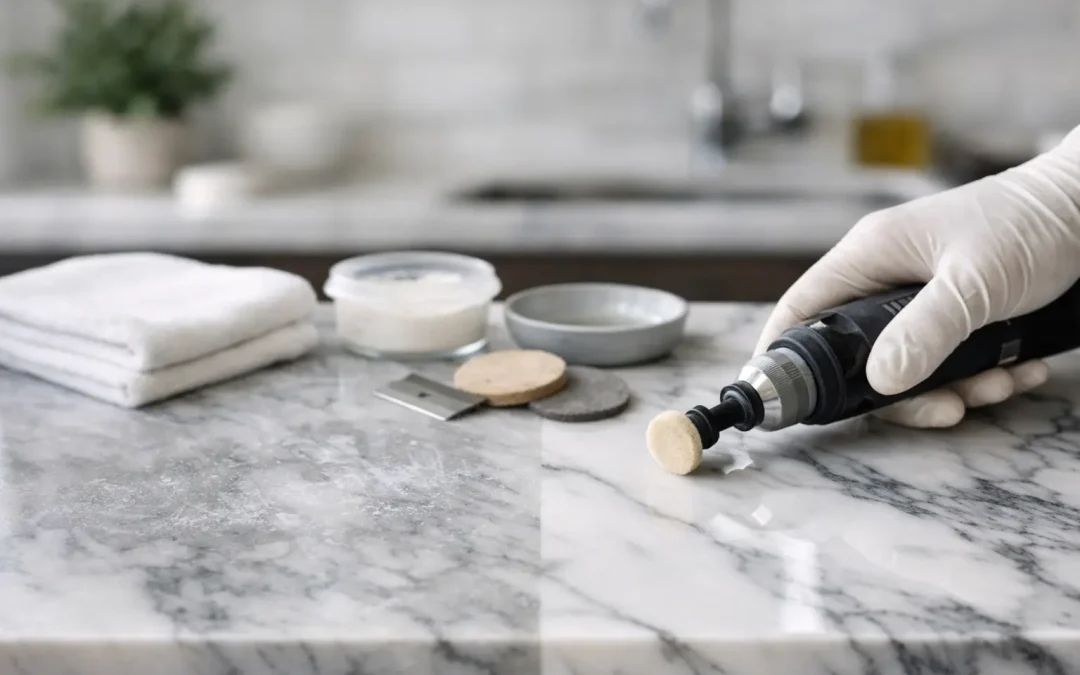
You notice it when the light hits just right – a dull ring near the sink, cloudy spots on the vanity, or a patch on the floor that looks worn even after cleaning. If you are asking, can etched marble be repaired, the short answer is yes. In many cases, etched marble can be restored, but the right solution depends on how deep the damage goes and where the marble is installed.
Etching is one of the most common problems homeowners see on marble. It can show up suddenly after a spill, or it can build slowly over time in kitchens, bathrooms, and entryways. The good news is that etching usually does not mean the stone needs to be replaced. More often, it means the surface finish has been damaged and needs the right kind of repair.
What etched marble really means
Marble is a calcium-based stone, which makes it beautiful and also sensitive to acids. Lemon juice, vinegar, some bathroom products, wine, and even certain household cleaners can react with the surface. Instead of leaving a stain, they actually change the finish of the stone.
That is why etched marble often looks lighter, duller, or rougher than the surrounding area. On polished marble, etching tends to stand out as a cloudy mark because it removes the shine. On honed marble, it may be less reflective to begin with, but you can still see a change in texture or color tone.
This matters because etching is different from staining, scratching, or deep surface wear. A stain changes the color from within the stone. A scratch cuts into the surface. Etching is a chemical reaction at the top layer. The repair has to match the actual problem, or the results will be disappointing.
Can etched marble be repaired at home?
Sometimes, yes. Small, light etches on a polished marble vanity top or tabletop may respond to a marble polishing powder or a specialty etch remover made for calcium-based stone. These products work best when the damage is minor and isolated.
Still, there is a limit to what a homeowner can fix successfully. Store-bought products can improve a small spot, but they can also create an uneven sheen if the surrounding finish is not blended properly. A polished patch in the middle of a larger dull area often ends up looking repaired rather than restored.
DIY repair is usually most realistic when the etched area is small, the marble is already polished, and the homeowner is comfortable following directions carefully. It becomes much less practical when the damage covers a larger section, appears in multiple areas, or affects a floor where consistency matters.
When professional repair is the better choice
If the etching is widespread, deep, or mixed with scratches and wear, professional restoration is usually the smarter option. The goal is not just to remove the mark. The goal is to return the marble to a uniform finish that looks right across the full surface.
That often means using professional polishing compounds, honing abrasives, and restoration equipment designed specifically for natural stone. On floors, it may also require refinishing a larger area so one section does not stand out from the rest. On countertops and vanities, proper repair often comes down to controlling gloss level, clarity, and smoothness.
This is where experience matters. Marble can be improved, but it can also be damaged further by using the wrong pad, the wrong product, or too much pressure. A surface that starts with etching can end up with swirl marks, blotchy shine, or a flattened finish if it is handled incorrectly.
How etched marble is repaired
The repair method depends on the finish of the stone and the severity of the damage. Light etching on polished marble may be corrected through repolishing. That process restores reflectivity and blends the affected area back into the surrounding surface.
For more noticeable damage, the marble may need honing first. Honing removes a very thin layer of stone to level out the etched area. After that, the surface can be polished to the desired sheen. If the marble has a honed finish rather than a glossy polish, the repair may stop at honing so the appearance stays consistent.
In cases where marble floors have traffic wear, acidic damage, and embedded soil all at once, restoration can involve multiple steps. Cleaning alone will not fix that type of surface. The stone needs to be mechanically refinished, then protected properly.
Why etching keeps coming back
A lot of homeowners clean marble regularly and still feel like the surface never looks right for long. That usually comes down to one issue: protection does not stop etching the way many people expect.
Sealer helps resist staining by slowing down how quickly liquids absorb into the stone. It does not make marble acid-proof. If orange juice, vinegar, or an acidic bathroom product sits on the surface, etching can still happen whether the marble is sealed or not.
That does not mean sealing is pointless. It still plays an important role in protecting the stone from stains and making maintenance easier. It just means homeowners need the right expectations. Sealing is one layer of care. Using stone-safe products and cleaning spills quickly is another.
The difference between repair and replacement
Many etched marble surfaces look worse than they really are. Because etching changes the finish, it can make the damage seem deeper or more permanent than it is. In reality, a skilled restoration process is often enough to bring the stone back.
Replacement usually makes sense only when the marble is cracked, badly broken, or damaged beyond practical repair. For most etching issues, restoration is the more cost-effective path. It also preserves the original material, which matters when the marble is part of a custom vanity, shower, or older floor installation.
For homeowners who want to protect the look and value of their home, restoration is often the better long-term decision. It addresses the actual condition of the surface without the cost and disruption of tearing it out.
What Gainesville homeowners should watch for
In busy homes, etched marble often shows up around bathroom sinks, kitchen counters, tub surrounds, and foyer floors. Toothpaste, skincare products, soap residue, food prep acids, and routine foot traffic can all contribute. The damage may start small, then spread as the finish becomes more vulnerable to everyday wear.
Florida homes also deal with sand, moisture, and heavy use patterns that can add to the problem. If the marble already has a softened finish from etching, grit tracked in from outside can make it look even duller over time. That is why regular maintenance and timely repair matter.
If you are seeing rings, splash marks, cloudy areas, or sections that no longer match the rest of the stone, it is worth having the surface evaluated before the wear becomes more extensive. In many cases, early repair is simpler and produces a cleaner final result.
How to keep marble looking better after repair
Once etched marble has been restored, a few habits make a real difference. Clean with a pH-neutral stone cleaner, not general-purpose sprays. Wipe acidic spills quickly instead of letting them sit. Use trays under toiletries and soaps on vanities, and mats or rugs in areas where water and products are used constantly.
It also helps to avoid abrasive scrubbing pads and powdered cleaners. Even if they do not etch the stone, they can wear down the finish and make the surface more vulnerable. Marble rewards gentle care and consistent upkeep.
If you are unsure what product is safe, it is better to ask than experiment. One wrong cleaner can create a new problem fast.
So, can etched marble be repaired?
Yes, etched marble can usually be repaired, and often very successfully. The main question is not whether it can be fixed, but how much restoration is needed to make it look uniform again. A light spot may respond to a small repair. A floor, vanity, or countertop with broader damage may need professional honing and polishing.
For homeowners in Gainesville and surrounding areas, the right next step is to stop treating the problem like ordinary dirt or wear. Etching is surface damage, and it responds best to stone-specific restoration. Natural Surface Restoration helps homeowners bring marble back to life with the right repair approach for the condition of the stone, not a one-size-fits-all fix.
If your marble still looks dull after cleaning, that is usually the surface telling you it needs restoration, not replacement.