
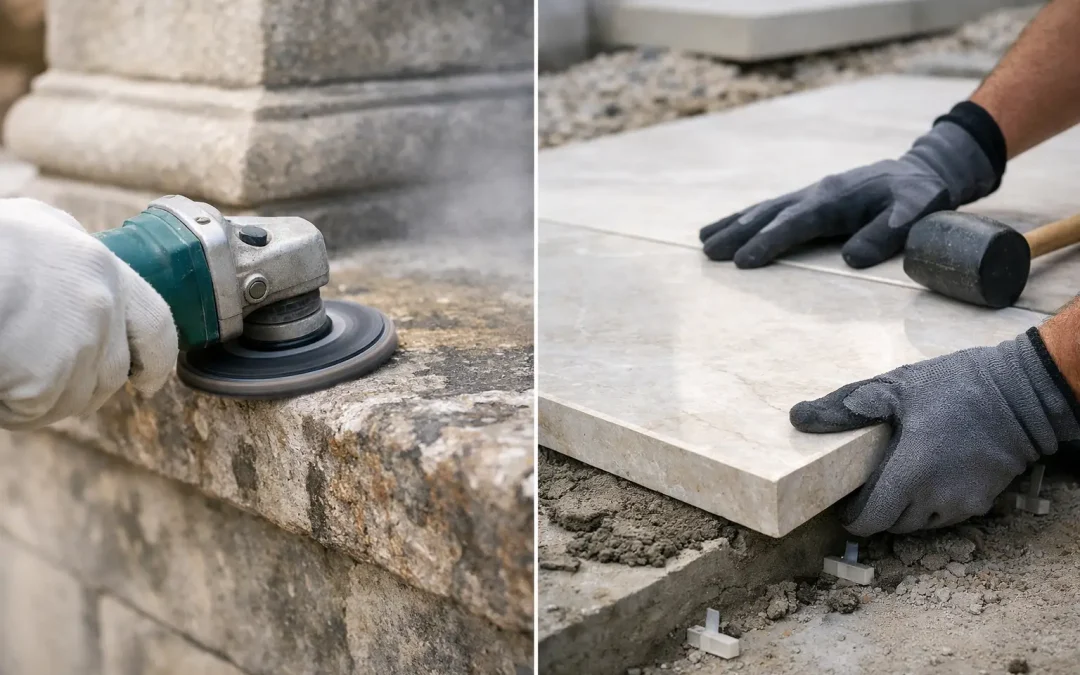
A chipped travertine floor, etched marble vanity, or dull stone shower can make an entire room feel older than it is. When homeowners start weighing stone restoration vs replacement, the real question is usually simpler: can this surface be brought back to life, or has it reached the point where starting over makes more sense?
In many homes across Gainesville and surrounding areas, natural stone looks worse long before it is actually beyond repair. Traffic wear, soap buildup, acidic etching, ground-in soil, hard water staining, and failed sealers can leave stone looking tired, uneven, or permanently damaged. But appearance alone does not always tell you whether replacement is necessary. A professional evaluation often reveals that the stone itself is still structurally sound and can be cleaned, honed, polished, repaired, and protected for far less disruption than a full tear-out.
Stone restoration vs replacement: what is the difference?
Stone restoration means keeping the existing material and correcting the issues that are making it look worn or damaged. Depending on the surface, that can include deep cleaning, stain treatment, scratch removal, crack or chip repair, honing, polishing, sealing, and grout improvement. The goal is not to cover up problems. It is to restore the actual surface so it looks better, performs better, and lasts longer.
Replacement means removing the existing stone and installing new material. Sometimes that is the right move, especially when the stone is broken beyond practical repair, the substrate underneath has failed, or the installation was done incorrectly from the start. But replacement is a much bigger project. It often involves demolition, disposal, material selection, installation labor, possible pattern matching issues, and downtime in the space.
For most homeowners, the choice comes down to condition, cost, appearance goals, and how much disruption they want to take on.
When restoration is usually the better option
Restoration is often the smarter choice when the stone has surface-level wear but remains fundamentally intact. This is common with marble floors that have etching and dull traffic lanes, travertine with minor holes or chips, limestone that has lost its finish, or granite countertops with staining and buildup that make them look older than they are.
A lot of stone problems are cosmetic, even when they look serious at first glance. Etching on marble can resemble permanent damage, but it often can be honed and refinished. Dullness may be caused by abrasion and residue, not stone failure. Discolored grout can make an entire floor look unsalvageable when the stone itself still has years of life left.
Restoration also makes sense when you want to preserve the original character of the material. Natural stone has variation that can be difficult to duplicate with new product. If the existing floor, shower, vanity, or countertop is part of the home’s overall look, restoring it usually gives you a better visual result than replacing only one section and hoping it blends.
For homeowners who care about keeping a home well maintained without taking on a full remodel, restoration is often the practical middle ground. You improve the appearance, correct wear, and add protection without turning the space into a construction zone.
Signs your stone may be a good candidate for restoration
If the stone is dull, scratched, etched, stained, lightly chipped, or uneven in sheen, restoration is worth serious consideration. The same is true if the grout is heavily soiled, the sealer has worn off, or the finish no longer matches from one area to another.
These are common service issues, not automatic replacement issues. A professional surface specialist can usually tell the difference quickly.
When replacement may be necessary
There are cases where replacement is the better long-term decision. If the stone is cracked through multiple tiles, actively loosening, or affected by a serious substrate problem, restoring the visible surface may not solve the root issue. Water damage underneath a shower floor, widespread tenting, major lippage caused by installation failure, or extensive breakage can all push the project toward replacement.
Replacement can also make sense when the homeowner wants a completely different look. If the goal is not to save the existing stone but to change the style, size, color, or layout, restoration will not deliver that outcome.
Another factor is previous damage that has gone too far. Some stone surfaces have been repeatedly cleaned with harsh chemicals, patched poorly, or neglected for so long that repair becomes less practical. Even then, it depends on the material. One badly damaged area does not always mean the whole installation has to go.
This is where honest assessment matters. A dependable restoration company should tell you when restoration is the right fit and when it is not.
Cost is only part of the decision
Homeowners often begin with price, and that is understandable. In many situations, restoration costs significantly less than replacement because you are keeping the existing material and avoiding demolition and reinstallation. But cost should not be viewed in isolation.
Replacement usually brings hidden expenses. Removing old stone can damage adjacent finishes. New stone may require lead time, material overage, design decisions, and additional labor beyond the visible surface. If the replacement material does not match nearby areas, the project can expand quickly.
Restoration is more controlled. You know what surface is staying, and the scope is usually tied to improving what is already there. That can make it easier to plan both financially and logistically.
Still, low cost alone is not the reason to restore. The better reason is value. If your existing stone can be corrected, protected, and returned to a clean, attractive finish, restoration often gives you more usable life from a premium material you have already paid for.
Appearance, performance, and long-term protection
The best restoration work does more than improve looks. It also improves function. Proper cleaning removes contaminants that wear the stone down. Honing and polishing create a more uniform finish. Sealing helps reduce future staining. Grout restoration can make maintenance easier and improve the appearance of the entire installation.
That matters in active households. Kitchen stone sees spills, bathrooms deal with moisture and product buildup, and floors take daily traffic. If the surface is restored correctly and then maintained properly, you are not just fixing an eyesore. You are extending the life of the material.
This is one reason many homeowners choose professional help instead of trying a store-bought product first. Stone is not one-size-fits-all. Marble, travertine, granite, limestone, terrazzo, and slate all respond differently to cleaning agents, abrasives, and sealers. The wrong approach can make the damage worse or create a patchy result that still needs correction.
Why local evaluation matters
Stone restoration vs replacement is rarely a decision that should be made from photos alone. A surface can look far worse in person than expected, or much more restorable than the homeowner assumed. The finish type, stone species, age of the installation, location of damage, and prior maintenance all affect the right path forward.
That is why local homeowners benefit from an estimate-based approach. A qualified company can inspect the actual condition, explain what is causing the problem, and set realistic expectations for the result. In North Central Florida homes, that practical guidance matters. Humidity, hard water, tracked-in sand, and everyday wear all show up differently depending on the room and material.
At Natural Surface Restoration, this kind of hands-on assessment is central to the process. Homeowners want a clear answer, not a sales pitch. If restoration can save the surface and deliver a strong result, that should be the recommendation. If replacement is the smarter investment, that should be stated plainly too.
The better question to ask
Instead of asking whether stone should always be restored or always replaced, ask what gives you the best result for the condition of the surface you already have. If the stone is structurally sound and the damage is mostly surface wear, restoration is often the better decision. If the installation has failed or the material is beyond practical repair, replacement may be worth it.
Good stone does not need to be torn out just because it looks worn. In many cases, it needs skilled correction and the right protection going forward. Before you commit to demolition, it is worth finding out how much life and beauty is still in the surface under your feet, on your counters, or in your shower.