
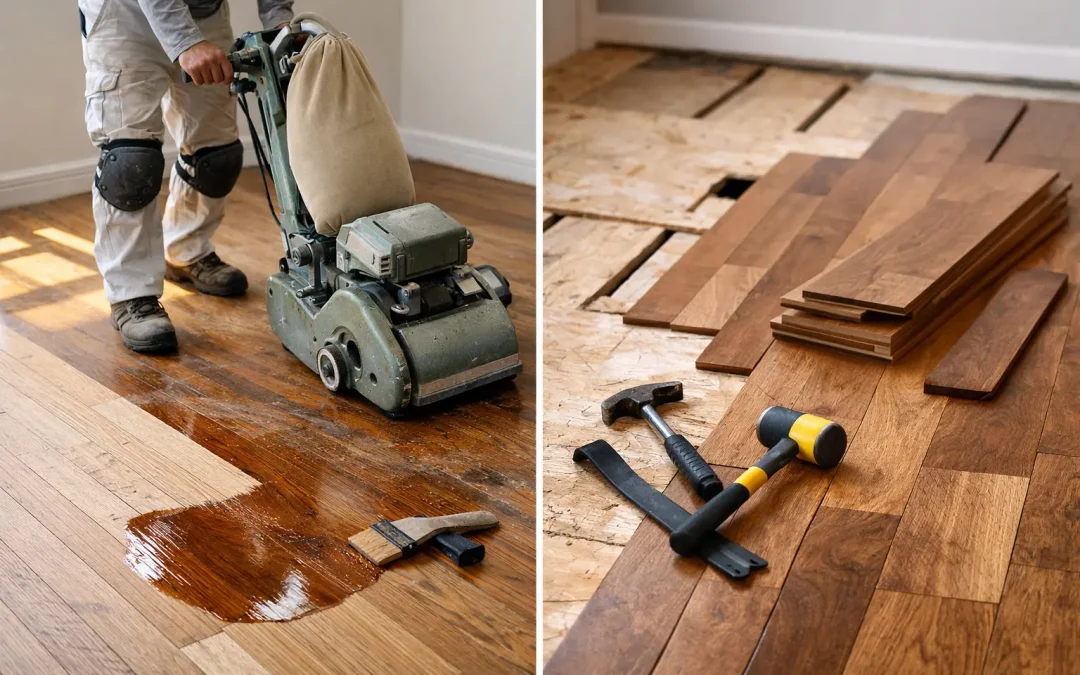
When hardwood floors start looking dull, scratched, faded, or uneven in color, most homeowners end up weighing the same question: wood floor refinishing vs replacement. The right answer depends on what is actually happening with the floor, not just how worn it looks at first glance. In many Gainesville-area homes, floors that seem ready for tear-out can often be restored and protected for years with the right professional work.
That matters because replacement is a much bigger project than many people expect. It affects budget, timing, dust control, material matching, trim, transitions, and sometimes even subfloor repairs. Refinishing is not always the answer, but it is often the smarter first option when the wood itself still has life left in it.
Wood floor refinishing vs replacement: what changes from one option to the other?
Refinishing keeps your existing wood floor in place. The surface is sanded to remove wear, scratches, stains, old finish, and minor surface imperfections, then a new finish is applied to restore appearance and protection. If boards are loose or isolated areas are damaged, those sections can sometimes be repaired before the floor is refinished.
Replacement means removing some or all of the existing floor and installing new material. That may be necessary when the boards are too damaged, too thin to sand again, heavily warped, water-soaked, infested, or structurally compromised. Replacement can also make sense when homeowners want to change the floor species, board width, or overall look and cannot achieve that through restoration.
For most homeowners, the real question is not which option is newer. It is which option solves the problem without overspending or shortening the life of the floor.
When refinishing is usually the better choice
If the floor has surface-level wear, refinishing is often the clear winner. Common examples include light to moderate scratches, dull traffic paths, fading from sunlight, small stains, minor pet wear, and finish breakdown. These issues may look dramatic, especially in strong natural light, but they usually affect the finish more than the wood itself.
Refinishing also makes sense when the boards are still stable and the floor has enough thickness left for sanding. Solid hardwood can often be refinished multiple times over its lifespan. Some engineered wood floors can also be refinished, but that depends on the thickness of the real wood veneer. That is why a hands-on evaluation matters. What looks like a candidate for replacement from a photo may actually respond very well to restoration.
Another reason homeowners choose refinishing is continuity. Keeping the original wood helps preserve the character of the home. If your existing floor runs through multiple rooms, refinishing avoids the challenge of matching a new product to older adjoining areas.
When replacement makes more sense
There are situations where refinishing would only delay a bigger problem. Deep water damage is a common one. If boards have cupped severely, buckled, rotted, or pulled away due to moisture, sanding alone will not correct the root issue. The cause of the water exposure has to be addressed, and badly affected flooring may need to be removed.
Replacement is also more likely when boards are split across large sections, when repeated past sanding has left the wood too thin, or when widespread movement suggests subfloor problems. In some homes, patch repairs from older work may be so extensive and mismatched that a full replacement produces a more consistent result.
Style changes can push the decision toward replacement too. If you want to switch from narrow strip oak to wide-plank white oak, for example, refinishing will not get you there. Refinishing improves what you already have. Replacement changes the material itself.
Cost is important, but it should not be the only factor
Most homeowners first compare wood floor refinishing vs replacement based on price, and that is understandable. In general, refinishing is less expensive than full replacement because you are preserving the existing material instead of paying for demolition, disposal, new flooring, new installation, and finishing.
But low upfront cost is not the only advantage. Refinishing can also protect the value of the original floor, especially in homes with real hardwood that was built to last. Tearing out a restorable floor and replacing it prematurely can cost more now and reduce long-term value if the new material is lower grade than what was already there.
That said, chasing the cheapest option can backfire. If a floor has major moisture damage or structural failure, refinishing may lead to disappointing results and force replacement later anyway. The better approach is to look at total value: how long the result will last, how well it solves the problem, and whether it preserves the quality of the home.
The condition of the wood tells the real story
A proper inspection matters more than appearance alone. Some floors look rough because the finish has worn away, while the wood underneath is still sound. Others look only mildly worn but have deeper issues such as black water staining, movement, hidden moisture damage, or previous repairs that were done poorly.
Professionals typically look at several things before recommending refinishing or replacement. They check the thickness and type of flooring, the severity and depth of damage, whether boards are loose or warped, whether pet stains have penetrated deeply, and whether the floor has already been sanded multiple times.
This is where local experience helps. In Florida homes, humidity and moisture conditions can affect wood in ways that are not always obvious at first glance. A floor may need more than cosmetic work if seasonal moisture has already changed its stability. On the other hand, some humidity-related concerns are manageable and do not automatically mean full replacement.
Refinishing has limits, but those limits are often farther than homeowners think
Many people assume scratches, dullness, or color variation mean the floor is finished for good. That is usually not the case. Refinishing can remove years of wear and dramatically improve the look of the floor without changing the entire room around it.
Still, refinishing is not magic. It cannot reverse structural failure. It cannot make severely water-damaged boards healthy again. And if the floor material is not suitable for another sanding, pushing ahead can do more harm than good.
A trustworthy recommendation should sound balanced. If a company tells you every floor should be replaced, that is a red flag. If they claim every damaged floor can be saved, that is another one. Good guidance starts with the actual condition of the material and the result you want.
Replacement is a bigger project than most people expect
Homeowners often compare only the finished look, but the process matters too. Replacement usually means moving furniture for longer, dealing with demolition debris, adjusting door clearances, managing transitions into neighboring rooms, and possibly repainting baseboards or trim. If the new flooring does not match the height of the old one, additional changes may be needed.
Refinishing can still be disruptive, but it is usually more contained because the original floor stays in place. For many households, especially those trying to preserve existing finishes and avoid a full interior chain reaction, that matters.
This is one reason restoration-focused companies often start by asking whether replacement is truly necessary. In many cases, preserving and restoring the original surface creates less disruption while still delivering a strong visual improvement.
How Gainesville homeowners should make the decision
The best next step is not guessing from online photos or assuming the worst because the floor looks tired. It is having the floor evaluated in person by a company that understands restoration, not just installation. The recommendation should account for the species of wood, the thickness, the pattern of wear, moisture exposure, repair options, and the finish you want moving forward.
For homeowners in Gainesville and surrounding North Central Florida communities, that local assessment is especially valuable. Homes in this region deal with humidity, tracked-in grit, pet wear, and day-to-day traffic that can age a wood floor unevenly. A professional who works with natural surfaces every day can tell the difference between wear that should be restored and damage that truly calls for replacement.
Natural Surface Restoration works with homeowners who want clear answers, not guesswork. If your wood floors are worn, scratched, faded, or showing signs of deeper damage, the smartest move is to get a straightforward evaluation and see what the floor can realistically become with professional restoration.
A floor does not need to be perfect to be worth saving. Sometimes it just needs the right hands on it before you decide to tear it out.