
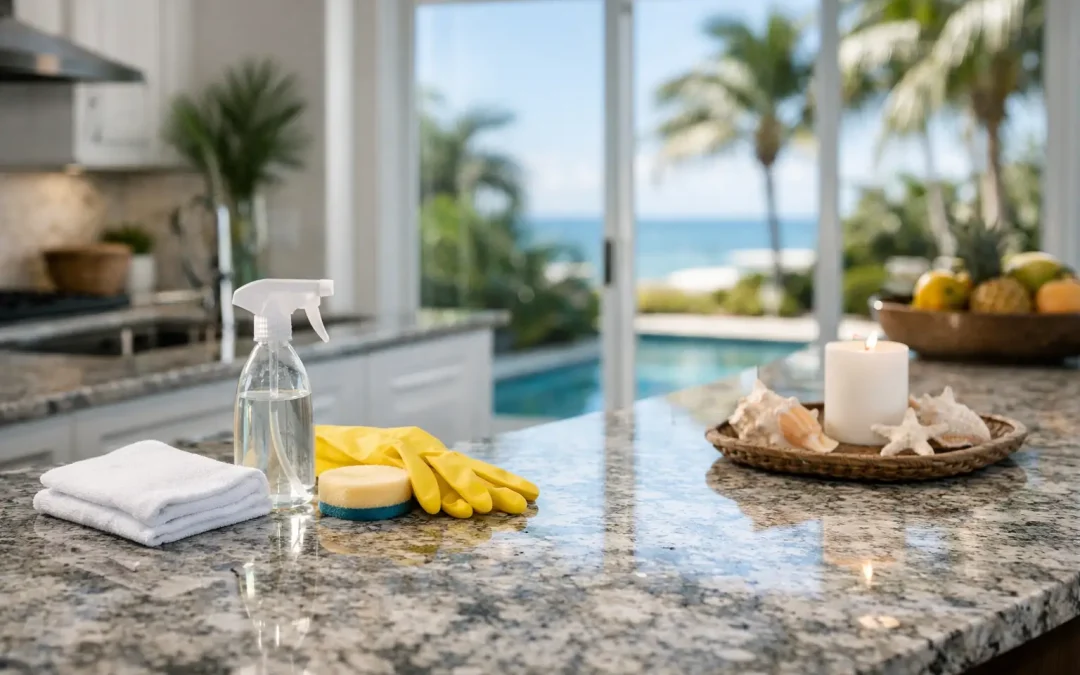
A granite countertop can look nearly indestructible right up until a dark oil spot appears beside the cooktop or a cloudy patch develops near the sink. Granite is tough, but it is still natural stone. Its appearance and performance depend on the finish, the stone’s natural porosity, the quality of its sealer, and the products used on it every day.
This granite countertop care guide explains what homeowners should do routinely, what to avoid, and when a surface needs more than household cleaning. A few sensible habits can keep granite looking polished and help prevent small problems from becoming permanent distractions.
Granite countertop care guide: start with daily cleaning
For ordinary crumbs, splashes, and fingerprints, use a soft microfiber cloth with warm water and a small amount of pH-neutral stone cleaner. Wipe the surface, then dry it with a second clean cloth. Drying matters because it removes residue that can leave the countertop looking streaky or dull, especially around faucets and prep areas.
A mild dish soap can work occasionally when there is grease to remove, but it should not be the default cleaner. Repeated soap use can leave behind a film that attracts smudges and makes a polished surface lose some of its clarity. If the countertop looks hazy even after cleaning, residue may be the problem rather than damage to the granite itself.
Clean spills as soon as practical. Water is rarely a concern on a properly sealed countertop, but cooking oil, wine, coffee, tomato sauce, citrus juice, and dark food coloring can create problems if they sit for hours. Blot a spill instead of scrubbing it across the stone. Then clean the area with a stone-safe product and dry it.
Products and habits that can damage granite
Granite is more resistant to scratches and chemicals than many natural stones, but resistance is not immunity. Avoid cleaners containing vinegar, lemon, citrus extracts, or other acids. These products may not visibly harm every granite slab immediately, yet repeated use can weaken sealer, affect certain mineral deposits, or dull the finish over time.
Bleach, ammonia, oven cleaner, powdered scrubbers, and abrasive pads also do not belong on granite. They can strip or discolor sealers, scratch polished finishes, and leave a surface harder to clean. Never combine cleaning products, particularly bleach and ammonia.
The same practical caution applies to countertop use. Granite can handle heat better than many manufactured surfaces, but hot cookware is not risk-free. Thermal shock, heat-sensitive resins in some slabs, and stress near seams or edges can all contribute to damage. Use a trivet under hot pans and avoid placing them directly over seams.
Cutting directly on granite can dull kitchen knives and may eventually mark the surface, especially near softer mineral areas. A cutting board is better for both the countertop and your knives. For bathrooms, place cosmetics, hair products, and toiletry bottles on a tray when possible. Oils, dyes, and acidic products can leave rings or stains around the sink.
Know whether your countertop needs sealing
Sealer does not create a plastic coating over granite. A penetrating sealer is designed to slow the absorption of liquids into the stone, giving you more time to clean a spill before it becomes a stain. It does not make granite completely stain-proof, and it will not repair existing dullness, chips, cracks, or etched areas.
How often granite needs sealing depends on the specific stone, the sealer previously used, and how heavily the countertop is used. Some dense granite needs little maintenance, while more absorbent material may benefit from periodic resealing. A kitchen island used for daily meal preparation usually needs more attention than a lightly used bathroom vanity.
A simple water check can offer a clue. Place a few drops of water on a clean, dry, inconspicuous area. If the stone quickly darkens as the water absorbs, the sealer may be weakening. If the water beads and the color does not change after several minutes, protection may still be performing well. This is only a screening test, though. Surface texture, natural color variation, and residues can affect what you see.
Before applying a sealer, make sure the countertop is truly clean and fully dry. Sealing over oils, haze, or residue can lock in the problem rather than solve it. Follow the sealer manufacturer’s directions exactly, particularly for dwell time and buffing. Too much product or poor removal can leave a cloudy finish.
How to handle common granite countertop problems
Not every mark on granite is a stain. Accurate diagnosis matters because the wrong remedy can make the appearance worse.
Dark spots and oil stains
A darkened area that remains after regular cleaning may be an absorbed oil stain. Cooking oils, grease, lotions, and some cosmetics are common causes. Do not reach for a harsh degreaser or abrasive scrubber. Depending on the stain and the stone, professional cleaning or a carefully selected poultice treatment may be needed to draw the contaminant out gradually.
White haze and water spots
Cloudiness near a sink or on the counter’s perimeter is often mineral buildup, soap residue, or cleaner film. Hard-water deposits are especially common in areas that stay wet. A stone-safe cleaner may remove light buildup, but avoid trying to dissolve the deposits with vinegar. If the haze persists, it may need professional restoration rather than stronger household chemicals.
Dull areas, scratches, and rough patches
Polished granite should reflect light consistently. A dull spot can come from residue, wear, a scratch, chemical exposure, or a change in the surface finish. Unlike softer stones such as marble, granite does not commonly etch from mild acids, but certain granite varieties and mineral inclusions can still react or lose their uniform sheen.
Roughness around the edge, a small chip, or a crack near a sink cutout should be inspected early. These areas can collect moisture and debris, and damage can spread with everyday use. Repair methods depend on the granite color, pattern, location, and the condition of the surrounding finish.
A realistic maintenance routine for busy homes
Most homeowners do not need an elaborate stone-care schedule. Daily wiping, prompt spill cleanup, and drying around the sink handle most routine needs. Once a week, use a pH-neutral stone cleaner to remove cooking residue and fingerprints more thoroughly.
Every few months, look closely at high-use areas around faucets, cooktops, seams, and edges. Check for persistent darkening, roughness, cloudiness, or chips. This approach is more useful than sealing on a fixed calendar date, because it responds to how your particular countertop is performing.
If your granite has lost its shine, developed stubborn stains, or has visible damage, replacing it is rarely the first answer. Natural Surface Restoration helps homeowners across North Central Florida clean, restore, polish, seal, and protect granite surfaces based on the condition of the stone rather than a one-size-fits-all treatment.
A granite countertop earns its value over years of use, not just on installation day. Treat it like the natural material it is: clean gently, protect it from avoidable damage, and address changes in the finish before they become harder to correct.