
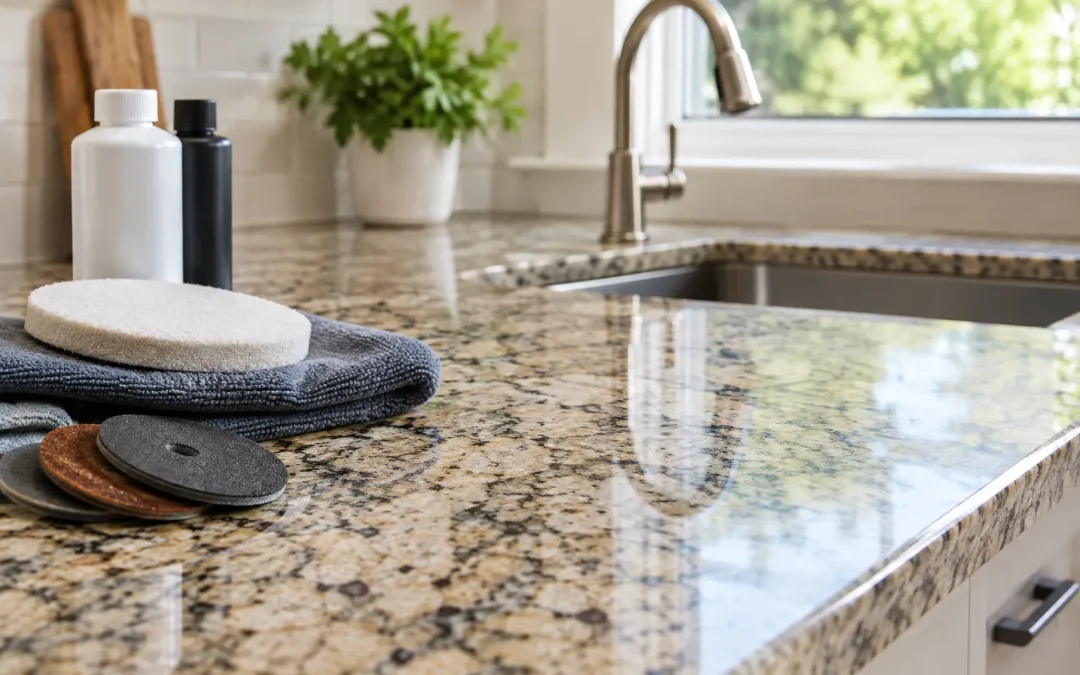
A granite countertop can look worn long before it is actually worn out. Cloudy patches around the sink, a dull finish near the cooktop, darkened areas, small chips, and stubborn stains can all make homeowners wonder whether they need a replacement. In many cases, the granite countertop restoration cost is far less than installing new stone, especially when the slab is structurally sound and the problem is limited to the finish, seams, or isolated damage.
The right price depends on what the countertop needs, not simply its square footage. Restoration may involve deep cleaning and sealing, chip repair, polishing, stain treatment, seam work, or a combination of services. A professional inspection helps identify the actual cause of the problem so money is spent on the repair that will make a visible, lasting difference.
What Affects Granite Countertop Restoration Cost?
Granite is one of the hardest natural stones used in homes, but it is not maintenance-free. Its price to restore varies because granite problems do not all require the same process, tools, or time. A countertop that looks dull because of residue needs a different approach than one with etched-looking spots, cracked seams, or chips along the edge.
The condition of the stone
A lightly dulled countertop may only need professional cleaning, removal of built-up residue, and fresh sealer. This is generally the least involved type of restoration. Homeowners often mistake soap film, cooking oils, hard-water deposits, or an aging topical product for permanent damage. Once those layers are removed, the original finish can look dramatically better.
More extensive work is needed when stains have penetrated the stone, chips expose rough edges, seams have opened, or surface damage affects the countertop’s appearance and use. Deep staining can require poultice treatment. Chips may need color-matched filling and shaping. A countertop with uneven sheen may need targeted honing and polishing rather than a basic cleaning.
Countertop size and layout
More square footage usually means more labor and materials, but layout matters just as much. A simple rectangular island is easier to service than a kitchen with multiple short runs, full-height backsplashes, tight corners, raised bars, and several sink or cooktop cutouts.
Edges also affect the scope. Straight edges are typically more accessible than detailed profiles with curves or decorative shaping. If a repair is needed near an undermount sink, faucet opening, or cooktop, the technician must work carefully around those areas to protect adjacent materials.
The type and severity of repairs
Not every flaw is merely cosmetic. Small edge chips are often straightforward to repair, but a larger break, a loose piece, or a crack caused by cabinet movement may require more preparation. The surrounding stone must be stabilized, matched, filled, leveled, and blended so the repair is as inconspicuous as possible.
Seam issues also vary. Some seams need cleaning and minor filling. Others have become uneven or separated because the countertop shifted or the cabinets settled. Repairing the visible seam can improve appearance, but movement below the stone should be addressed when it is contributing to the issue. Restoration should solve the underlying problem where possible, not just cover it up.
Access and protection requirements
Kitchen countertops are surrounded by cabinets, walls, appliances, and fixtures. Proper restoration includes protecting those nearby surfaces and keeping the work area controlled. Access becomes more complicated in occupied kitchens, homes with limited workspace, or countertops with extensive backsplash details.
This does not mean restoration is disruptive in the same way replacement can be. In fact, keeping the existing granite often avoids demolition, plumbing disconnects, cabinet risk, and the time involved in fabricating a new slab. Still, the work needs to be planned around the countertop’s condition and the home’s layout.
Typical Granite Restoration Services and Value
A clear estimate should describe the work being recommended. That gives homeowners a better basis for comparison than a single broad price with no explanation of what is included.
Professional granite cleaning removes embedded grime, residues, and surface films that ordinary cleaners leave behind. This service can be especially valuable in kitchens where the stone has gradually lost clarity or developed a sticky, uneven feel. It is often paired with sealing after the countertop is fully cleaned and dried.
Granite sealing helps reduce the stone’s absorption of water, oils, and food-related spills. Sealer is not a force field. It does not prevent every stain, eliminate the need for prompt cleanup, or repair existing damage. Its job is to give homeowners more time to wipe up a spill before it penetrates the stone. The best sealing plan depends on the granite’s porosity and how the kitchen is used.
Chip repair focuses on restoring a damaged edge, corner, or surface area. A skilled repair can make a small defect much less noticeable and eliminate a sharp or rough spot. Exact invisibility is not always realistic, particularly on heavily patterned granite or large breaks, but careful color matching and finish blending can produce a strong improvement.
Polishing and honing may be appropriate when the granite’s finish is inconsistent or when specific areas have lost their sheen. This work requires judgment. Granite has a naturally varied appearance, and aggressive polishing is not the answer to every dull-looking section. The goal is to correct the issue without creating an artificially different patch beside the original finish.
When Restoration Is More Sensible Than Replacement
Replacement can be the right choice if the granite is badly fractured, improperly supported, extensively damaged, or no longer fits a planned remodel. But many homeowners replace countertops because they assume restoration cannot solve visible wear. That assumption can be expensive.
Restoration is usually worth considering when the slab is intact, the color and style still work in the room, and the concerns are stains, dullness, minor chips, residue, or aging sealer. It preserves a material that is already fitted to the cabinets and avoids the cascade of costs that can come with removal and installation.
There is also a practical benefit for homeowners who plan to sell. A clean, polished, well-protected granite countertop presents far better than one with dark spots, cloudy areas, or chipped edges. Restoring the surface can improve the overall impression of the kitchen without committing to a full renovation.
How to Get an Accurate Restoration Estimate
The most reliable way to understand pricing is to have the granite evaluated in person. Photos can be helpful, but lighting, camera settings, and surface residue can hide the difference between a simple cleaning issue and damage that needs more detailed work.
Before requesting an estimate, avoid applying new polish, wax, or heavy countertop products in an attempt to improve the appearance. These products can temporarily mask the condition and make diagnosis harder. If possible, note when the issue started, what cleaners have been used, and whether a stain appeared after a specific spill or leak.
Ask what condition is causing the visible problem, which restoration steps are included, and what result is realistic. A dependable estimate should separate necessary repairs from optional improvements. For example, sealing may be recommended after cleaning, while a small chip repair may be a separate priority based on its location and visibility.
For homeowners in Gainesville and across North Central Florida, Natural Surface Restoration evaluates granite with the full surface in mind – not just the most obvious spot. That approach helps determine whether the countertop needs cleaning and protection, detailed repair, or a more involved restoration plan.
Protecting Your Granite After Restoration
Good daily habits help protect the value of restoration work. Use a pH-neutral stone cleaner or mild soap followed by a clean, damp cloth, then dry the surface rather than allowing water to sit. Wipe up oils, wine, citrus, coffee, and sauces promptly, particularly around seams and the sink.
Avoid abrasive powders, harsh degreasers, bleach-based products, and cleaners that leave a waxy shine. They can dull the surface, leave residue, or interfere with sealer performance. Use cutting boards and trivets as well. Granite handles normal kitchen heat well, but sudden extreme temperature changes can create unnecessary stress near seams or weak points.
A restored granite countertop should look cared for, not coated in temporary shine. If yours has lost its clean, even appearance or has damage that keeps drawing your eye, an estimate can clarify what can be repaired and whether restoration is the better investment.