
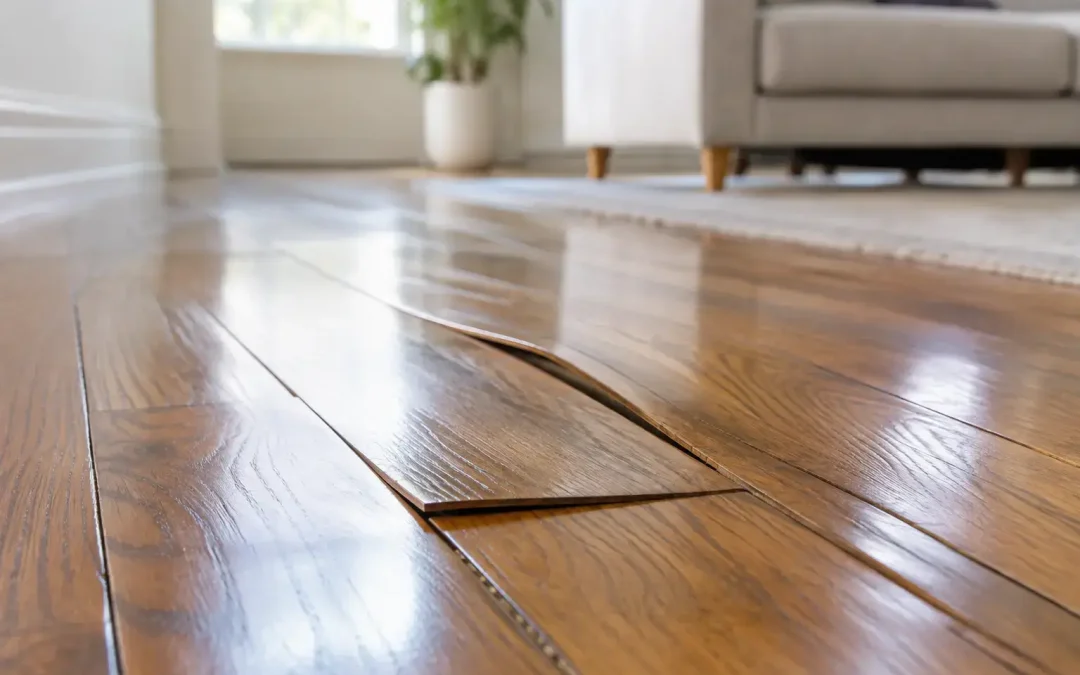
A wood floor can look perfectly normal one week and feel ridged, uneven, or wavy the next. If the edges of individual boards are higher than their centers, you are seeing cupping. Homeowners often ask, why are wood floors cupping when there has been no obvious flood or spill. The answer is almost always moisture, but finding where that moisture is coming from is what protects the floor from further damage.
Cupping does not automatically mean your hardwood needs replacement. In many cases, the floor can stabilize and may be restored once the moisture issue is corrected. The right response depends on the wood species, the type of flooring, the finish, how long the floor has been affected, and whether moisture is still present.
What Wood Floor Cupping Looks Like
Cupping occurs when a wood plank absorbs more moisture from below than from above. Wood expands across its width as it takes on moisture. When the underside expands more than the finished face, the board edges rise and the center dips slightly, creating a shallow cup shape.
Run your hand across the boards rather than just looking at them. A cupped floor feels uneven from side to side, with raised seams between planks. The effect may appear in one area, such as near an exterior wall or dishwasher, or across an entire room. The location offers useful clues about the source.
Cupping is different from gaps between boards, which are commonly caused by dry indoor air and seasonal contraction. It is also different from crowning, where the center of the board sits higher than the edges. Both conditions involve moisture, but they call for different diagnosis and repair decisions.
Why Are Wood Floors Cupping? Moisture Is Usually Below
A hardwood floor is not sealed against moisture forever. Finish slows the movement of water vapor and liquid water, but wood remains a natural material that responds to its environment. In North Central Florida, high humidity and moisture beneath a home can put constant pressure on a wood floor, especially in rooms over crawl spaces or concrete slabs.
A leak or water event
A leaking refrigerator line, dishwasher connection, plumbing pipe, roof intrusion, or overflowing fixture can introduce enough water to cup boards quickly. The water source may be hidden. By the time the floor feels uneven, moisture may have already traveled beneath the finish and into surrounding materials.
If cupping is concentrated around an appliance, bathroom wall, exterior door, or window, treat a leak as a strong possibility. Stop the source first. Cleaning the floor or adding another coat of finish will not solve moisture trapped underneath it.
Moisture from a crawl space or slab
Wood floors installed over crawl spaces are vulnerable when the space below has poor drainage, inadequate vapor protection, standing water, or consistently elevated humidity. Moisture can rise into the subfloor and then into the hardwood from below.
Concrete slabs can create a similar problem. A slab may release moisture vapor, particularly if flooring was installed before the concrete was sufficiently dry or without the correct moisture-control system. This type of cupping may appear gradually and affect a broad section of the floor rather than a small, obvious spot.
High indoor humidity
Sometimes there is no plumbing leak at all. Extended periods of high indoor humidity can raise the moisture content of wood enough to cause movement, particularly when air conditioning is off, undersized, or not controlling humidity effectively. Closed-up homes, vacant properties, and rooms with limited air circulation are common trouble spots.
Indoor humidity is only part of the picture. If the underside of the floor is much damper than the top surface, cupping is more likely. That moisture imbalance matters more than a single humidity reading taken after the problem has appeared.
Installation conditions and material issues
Wood flooring needs time to acclimate to the home before installation. It also needs the proper subfloor preparation, moisture testing, expansion space, and installation method for the product being used. Solid hardwood, engineered wood, and site-finished floors do not all tolerate moisture exposure in the same way.
An installation issue can contribute to cupping, but it should not be assumed without testing. A properly installed floor can still cup after a leak or prolonged humidity exposure. Conversely, refinishing a floor before it has fully dried can create a second problem: crowning.
What to Do When You Notice Cupping
The first priority is drying and diagnosis, not sanding. Turning on the air conditioning, using dehumidification when appropriate, and maintaining steady indoor conditions can help prevent additional movement. If there was a known water event, address the water source immediately and have the affected area evaluated for moisture in the subfloor and surrounding structure.
Avoid placing rugs over the area while it is damp. Rugs reduce airflow and can hold moisture against the finish. Also avoid aggressive cleaning, steam mops, wet mopping, and oil-based products. These steps can add moisture or leave residue that complicates later restoration.
Most importantly, do not rush to sand a cupped floor flat. Wood often relaxes as it dries. Sanding while the boards are still swollen removes material from the raised edges. When the floor eventually returns closer to its normal moisture level, those over-sanded edges can leave the boards crowned, with the centers higher than the sides. That mistake can make an otherwise recoverable floor look worse.
Can a Cupped Wood Floor Return to Normal?
It depends on the cause, the length of exposure, and the severity of the distortion. Mild cupping from a short-term humidity increase may lessen substantially after stable conditions are restored. This can take time. Wood does not dry evenly or instantly, and forcing rapid drying can create other stresses.
More severe cupping may leave permanent movement, finish damage, staining, loosened boards, or gaps at the joints. If the finish has cracked or water has penetrated deeply, refinishing may be needed after the floor reaches an acceptable and stable moisture condition. Boards that have delaminated, warped beyond repair, or suffered structural damage may need selective replacement before refinishing.
Engineered wood deserves special attention. Its layered construction can make it more stable than solid hardwood under normal conditions, but prolonged moisture can cause veneer damage or delamination. Because engineered floors have a limited wear layer, sanding must be evaluated carefully rather than treated as an automatic solution.
How a Professional Evaluation Helps
A proper assessment looks beyond the visible waves in the boards. It should consider moisture readings in the wood and subfloor, the pattern of the damage, the floor type, the finish condition, and nearby sources of water or humidity. This helps determine whether the floor should be allowed more drying time, whether repairs are needed, or whether restoration can move forward safely.
Once the moisture source is corrected and the floor has stabilized, restoration may include targeted board repair, careful sanding, stain matching, and refinishing. The objective is not merely to make the floor look smoother. It is to restore a durable, even surface without removing more wood than necessary.
Natural Surface Restoration evaluates wood floors with that long-term result in mind. For homeowners in Gainesville and surrounding North Central Florida communities, a professional assessment can clarify whether a cupped floor can be restored and what needs to happen before refinishing begins.
Preventing Wood Floor Cupping in the Future
Prevention starts with controlling water where it enters the home. Repair plumbing leaks promptly, keep exterior doors and windows well sealed, and do not let spills sit on a wood floor. Use mats near exterior entries, but lift them periodically so moisture cannot remain trapped underneath.
Maintain consistent indoor temperature and humidity as much as practical, especially during humid Florida weather or when the home is unoccupied. If the floor sits over a crawl space, make sure drainage, vapor protection, and ventilation are addressed as part of the home’s overall moisture-control plan. For floors over concrete, moisture testing and the correct installation system are essential before new hardwood is installed.
A cupped floor is the floor telling you that its moisture balance has changed. Respond to that message early, give the wood time to stabilize, and make restoration decisions only after the underlying cause is under control. That approach gives your floor its best chance to regain both its appearance and its service life.